
Table of Contents
- Start With a Back to School Clothing Checklist
- Pick Fabrics That Survive the School Year
- How to Prevent Kids Clothes From Shrinking
- Build Layers for Seasonal Transition
- How to Organize Kids Clothes for School Mornings
- Match Outfits to School Dress Codes and Age
- Plan a Capsule Wardrobe on a Budget
- Frequently Asked Questions
Last Updated: September 14, 2026
Start With a Back to School Clothing Checklist
Building a back to school clothing checklist before you buy a single item is the difference between knowing how to dress kids for school in a way that lasts until June and one that collapses by October. Most parents shop reactively, grabbing whatever looks cute in the moment. That approach costs more and leaves gaps.
The core tenet of how to dress kids for school comes down to one idea: buy fewer, better pieces that mix and match. A tight checklist forces that discipline.
The Core 10-Item Starter Wardrobe
This list covers a full school week without daily panic:
- Five tops (t-shirts, polos, or long-sleeve tees)
- Two pairs of durable pants or jeans
- Two pairs of shorts or joggers for warmer days
- One sweatshirt or hoodie for layering
- One lightweight jacket
- One pair of everyday sneakers
- One pair of backup shoes
- Seven pairs of socks
- Seven pairs of underwear
- One bookbag or tote for supplies
That's it. Ten categories, roughly 25 items, enough for a full rotation with laundry every five to seven days.
A common mistake is buying 15 t-shirts and two pairs of pants. Kids wear the pants harder and outgrow them faster. Balance the ratio.
Pick Fabrics That Survive the School Year
Fabric choice matters more than brand name. A cheap cotton tee that holds its shape outperforms an expensive blended top that pills after three washes.
Breathable cotton remains the gold standard for everyday tops. It handles recess, art class, and lunch spills without trapping heat. For activewear and bottoms, look for cotton-polyester blends: they resist wrinkles, dry faster, and hold color longer.
What most guides miss is the print quality question. Screen-printed graphics on 100% cotton tend to crack after repeated washing, while prints on blended fabrics hold up better. If your kid insists on graphic tees, check the fabric tag first.
For bottoms, denim and twill are the workhorses. Both handle playground abrasion and hold up to frequent washing. Joggers work for younger kids but wear faster at the knees.
Footwear needs support, not style alone. Sneakers with a firm heel counter and cushioned midsole protect growing feet during daily wear. Replace them when the tread flattens, usually every three to four months for active kids.
American Academy of Pediatrics guidance on children's footwear
How to Prevent Kids Clothes From Shrinking
Shrinkage is the number one complaint parents have about kids' clothing, and it's almost always preventable. The culprit is heat, not the fabric itself.
Cotton fibers contract when exposed to high temperatures in the washer and dryer. Here's how to prevent kids clothes from shrinking:
- Wash in cold water (below 30°C / 85°F)
- Tumble dry on low or air-dry
- Avoid overloading the dryer, which traps heat
- Skip fabric softener, which breaks down fibers over time
- Turn printed items inside out before washing
Pre-shrunk cotton still shrinks slightly on the first wash, typically 2-5% (Circular Economy and Sustainability of the Clothing and Textile Industry). Buy one size up for 100% cotton items if your child is between sizes.
For blended fabrics, shrinkage is minimal. Polyester and elastane blends hold their original dimensions far better than pure cotton.
Build Layers for Seasonal Transition
Layering is how you get one wardrobe to cover September through June without buying twice. A base layer, a mid-layer, and an outer layer handle almost every temperature swing.
Base layers should be breathable cotton or a moisture-wicking blend. Mid-layers, like a hoodie or fleece pullover, add warmth without bulk. Outer layers handle wind and rain.
The Walabookies Kids' Hooded Sweatshirt is a solid mid-layer example: midweight fleece, a roomy kangaroo pocket, and a playful graphic that kids actually want to wear. At $39.99, it's built for the kind of daily rotation that kills cheaper hoodies.

For seasonal transition, the rule is simple: dress for the afternoon, not the morning. Kids shed layers by 10 a.m. A light jacket over a t-shirt beats a heavy coat over a sweater.
How to Organize Kids Clothes for School Mornings
Organizing kids clothes for school mornings comes down to one principle: remove every decision from the child's morning path. The night before is when choices happen.
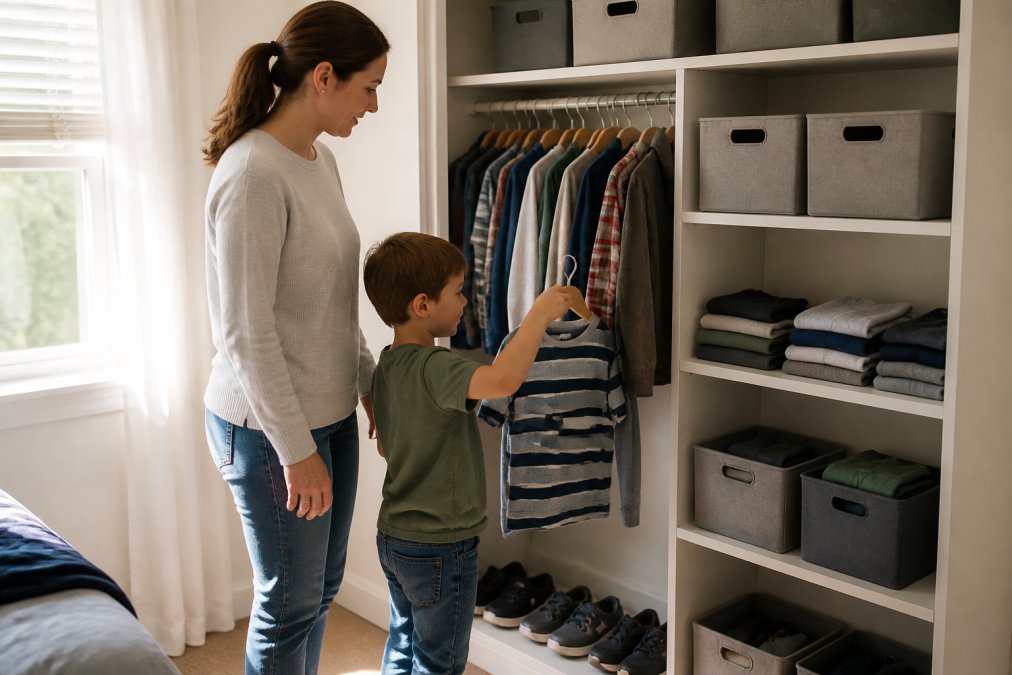
A system that works for most families:
- Sunday prep: Lay out five full outfits, one per school day
- Hanging organizer: One slot per day, labeled Monday through Friday
- Low drawers: Socks, underwear, and accessories at kid height
- Laundry basket in each room: No more lost socks under beds
- Backpack station by the door: Bookbag, water bottle, and shoes together
The night-before routine eliminates the 7 a.m. negotiation. Kids pick their outfit after dinner, when everyone has more patience.

A water bottle that lives in the backpack, not the kitchen, saves five minutes every morning. The Kids' Tritan Water Bottle at $26.99 has a flip-straw lid that younger kids can manage without help.
Match Outfits to School Dress Codes and Age
School dress codes vary widely, and ignoring them means a call home or a trip to the office. Check your school's handbook before back-to-school shopping, not after. The trick is translating a dense policy document into a shopping filter you can actually use in a store aisle.
Decode the Handbook Before You Shop
Most handbooks bury the dress code in a student conduct section. Read it with a highlighter and pull out four categories:
- Coverage rules: strap width (often "two fingers wide" or "three inches"), hem length (fingertip rule, or shorts that reach mid-thigh), and whether midriffs must be covered.
- Footwear rules: many elementary and middle schools ban open-toed shoes, flip-flops, wheeled shoes, and sometimes Crocs for safety and PE reasons.
- Graphics and messaging: profanity, alcohol/tobacco references, and gang-affiliated colors or symbols are near-universal bans. Some schools also restrict violent imagery.
- Headwear and accessories: hats indoors, hoods up in class, bandanas, and sometimes smartwatches during tests.
Write those four rules on a sticky note and keep it in your wallet during back-to-school shopping. If a piece fails any rule, it doesn't come home, no matter how cute it is.
Age-by-Age Dressing Guide
Preschool and pre-K (ages 3-5): Independence beats style. Elastic waistbands, velcro or slip-on shoes, and simple pullovers let kids handle bathroom trips alone. Avoid overalls, back buttons, and tight leggings that are hard to pull down in a hurry. One-piece outfits look adorable but create bathroom emergencies.
Early elementary (ages 6-8): Comfort-focused with a bit more choice. Elastic waists still win, but kids this age can manage zippers and laces with practice. Graphic tees are fine as long as the graphic passes the handbook's messaging rule. Sneakers with velcro straps bridge the gap before kids master laces.
Upper elementary (ages 9-11): Style awareness kicks in hard. This is where a few versatile basics plus two or three graphic tees earn their keep. Kids start self-selecting, so involve them in the capsule palette or you'll buy clothes they refuse to wear.
Middle school (ages 12-14): Dress codes tighten at many schools here, and so does peer pressure. Check whether the school requires collared shirts, bans hoodies, or enforces a color palette. Buy one or two "safe" outfits that meet the strictest interpretation of the code for days when nothing else works.
The Picture Day and Event Rule
For school events, picture day, or a concert, one polished look is enough. A simple dress or a collared shirt with clean pants covers every formal occasion on the calendar. A common mistake is buying a full formal outfit for a single event. Buy one versatile piece that works for multiple occasions instead, and rotate it.
When the Code Conflicts With Your Child
If a rule clashes with your child's sensory needs, religious practice, or gender expression, most schools have a process to request an accommodation. Ask the front office for the dress-code exemption form or the name of the administrator who handles it. Bring it up before the first day, not after a write-up.
Plan a Capsule Wardrobe on a Budget
A capsule wardrobe for kids is a small, coordinated set of clothing where every piece works with every other piece. Done right, it cuts your clothing spend significantly while giving your child more outfit options, not fewer. It's also the single best structure for kids with sensory sensitivities, because you only buy fabrics and cuts you already know your child tolerates.
The Capsule Math
Ten tops and five bottoms in coordinating colors create 50 possible combinations. Ten tops and five bottoms in random colors create maybe 15 that actually look good together. The math rewards discipline: pick a base palette of two neutrals (navy, gray, black, or tan) plus two accent colors your child actually likes, buy bottoms in neutrals only, and let tops carry the color and personality.
Budget-conscious capsule planning:
- Pick a base palette (two neutrals plus two accent colors)
- Buy bottoms in neutrals only
- Let tops carry the color and personality
- Add one or two statement pieces for school events
- Replace items as they wear out, not on a fixed schedule
Sensory-Friendly Capsule Building
This is where most back-to-school guides stop short, and it's the part that matters most for neurodivergent kids. A common pattern among occupational therapists and parents of autistic or ADHD children is that the fabric tag, the seam, and the waistband cause more morning meltdowns than the color or style ever will.
Build the capsule around what your child already wears without complaint. Then apply these filters:
- Tags: cut them out, or buy tagless brands. A scratchy neck tag is the number one sensory complaint.
- Seams: flatlock or seamless construction on socks and underwear prevents the ridge that rubs under a shoe or waistband.
- Waistbands: covered elastic or wide soft waistbands beat exposed elastic, which digs in when kids sit on the floor.
- Fabric feel: brushed cotton and modal feel softer than standard cotton jersey. Avoid stiff denim and scratchy wool against the skin.
- Fit: snug is worse than loose for most sensory-sensitive kids. Size up one if the shoulders or waist feel tight.
- Fasteners: velcro and magnetic closures beat buttons and zippers for kids who struggle with fine motor or hate the feel of metal.
Once you know which fabrics and cuts your child tolerates, you buy only those. No more mornings ruined by a scratchy tag or a too-tight waistband, and no more money wasted on clothes that hang in the closet.
Laundry and Longevity Inside the Capsule
A capsule only works if the pieces survive the rotation. Machine-washable, stain-resistant pieces last longer, which is the whole point. A few habits extend the life of every item:
- Treat stains the same day. Blot, don't rub, and rinse with cold water before the stain sets.
- Wash graphic tees inside out to protect the print.
- Air-dry anything with elastane or spandex, since dryer heat breaks down stretch fibers.
- Keep a small stain pen in the backpack for lunch and art-class spills.
A Tote Bag at $20.99 handles library days, playdates, and after-school activities without the bulk of a full backpack, and it fits inside the capsule system as the one bag that works for everything.

Frequently Asked Questions
What is the 3-3-3 rule for clothes?
The 3-3-3 rule is a packing and wardrobe shortcut: three tops, three bottoms, and three pairs of socks or underwear per short trip or rotation cycle. For school, some parents stretch it to three outfits per day-type (school, sport, weekend). It works best as a starting point for a capsule wardrobe, then you add extra tops and bottoms for laundry days. It keeps drawers manageable without overbuying.
How do I prevent kids' clothes from shrinking after washing?
Wash in cold water on a gentle cycle and skip the high-heat dryer. Cotton and cotton-blend items shrink most when exposed to hot water and hot air. Turn graphic tees and hoodies inside out, use a low spin speed, and lay knits flat to dry. If you must tumble dry, choose low heat and pull items out slightly damp. This keeps fabric longevity intact and helps how to dress kids for school stay simple because clothes keep their fit.
What are the essential items for a back-to-school wardrobe?
A practical back to school clothing checklist covers five tops, three bottoms, one hoodie or sweatshirt, one light jacket, two pairs of sneakers, and socks and underwear for a full week. Add a bookbag and a water bottle to complete the set. Choose versatile basics in colors that mix and match. This gives you enough daily wear options without overflowing the closet or blowing the budget.
How can I help kids choose their own school outfits?
Give them a limited choice, not the whole closet. Lay out two or three pre-approved outfits the night before and let them pick one. Group clothes by outfit in labeled drawers or hanging cubbies so they can grab a complete set. Let them express style through graphic tees, colors, or accessories within the school dress code. This builds independence while keeping mornings fast and stress-free.