
Table of Contents
- Why 8-Year-Olds Get Picky About Clothes
- How to Dress a Picky Child Without the Morning Fight
- Sensory Friendly Clothes for Kids: What to Look For
- Building a Capsule Wardrobe for 8 Year Olds
- Stylish Outfits for Picky 8 Year Olds: 5 Mix-and-Match Ideas
- Budget-Friendly Shopping Strategies That Still Feel Stylish
- Sustainable and Circular Fashion for Kids
- Frequently Asked Questions
Last Updated: September 25, 2026
Why 8-Year-Olds Get Picky About Clothes
Around their eighth birthday, a switch flips: the child who wore whatever you laid out now has loud opinions. This guide from Walabookies breaks down why stylish outfits for picky 8 year olds have become a negotiation, and how to make mornings calmer.
The Psychology of Clothing Autonomy at Eight
Clothing autonomy is a child's ability to make their own decisions about what they wear, from fabric and fit to color and style. At eight, children are developmentally ready to exercise it, whether or not adults cooperate.
How to Dress a Picky Child Without the Morning Fight
The fastest way to end the morning battle is to stop making the decision for them and start making it with them. Children who feel they had a real say resist far less, even when every option was pre-approved. Avoid the open-ended "what do you want to wear today?", it invites a standoff.
The Two-Choice Method That Actually Works
The two-choice method is simple: offer exactly two acceptable options and let the child pick one. Both should already be weather-appropriate, school-appropriate, and clean.
- Lay both outfits out the night before. Decision fatigue is real at 7 a.m. A tired child picks fights; a rested one picks shirts.
- Keep both choices genuinely good. Never offer one option you secretly want and one you don't. Kids detect that instantly.
- Rotate who chooses first. On alternating days, let the child pick the top and you pick the bottoms, then swap.
- Name the choice out loud. "The blue graphic tee with jeans, or the hoodie with the joggers?" Concrete language speeds up the decision.
Sensory Friendly Clothes for Kids: What to Look For
Sensory friendly clothes for kids are garments engineered to minimize tactile irritation, using soft fabrics, flat seams, and tagless construction so that children with texture sensitivity or sensory-processing differences can wear them comfortably all day. For a picky eight-year-old, this category is often the biggest unlock.
The Difference Between General Texture Sensitivity and SPD
Most articles on picky dressers stop at "some kids don't like itchy tags." That undersells the problem: there is a meaningful difference between a child who prefers soft clothes and one whose nervous system processes touch differently.
- General texture sensitivity is common and usually mild. The child avoids certain fabrics but can wear them briefly without distress. A tagless tee and a soft waistband typically solve it.
- Sensory-processing differences (sometimes discussed under the umbrella of sensory processing disorder, or SPD) involve a nervous system that over- or under-responds to touch. For these children, a single seam can feel like a pebble in a shoe all day. Clothing refusal is often paired with other aversions: loud rooms, food textures, sock seams, hair brushing.
The Comfort Checklist, With the Technical Details
The checklist below is what most practitioners and parents of sensory-sensitive kids converge on.
- Tear-away or printed labels instead of sewn-in tags at the neck. Printed labels are even better than tear-away, because there is nothing left to scratch after the tear.
- Flatlock or covered seams at shoulders and side seams, not raw overlock stitching. Flatlock seams lie flat against the skin; overlock seams create a raised ridge that many kids can feel through the fabric.
- Soft, breathable cotton or a cotton-rich blend, especially for anything worn against the skin. Airlume combed and ring-spun cotton is a common choice because the combing removes short fibers that cause roughness.
- Stretch waistbands with covered elastic rather than exposed elastic or rigid button closures. A covered waistband eliminates the most common complaint about pants.
- No scratchy embroidery on the inside of the garment where it touches skin. Decoration should be on the outside only.
- Pre-washed or pre-shrunk fabric so the fit does not shift after the first laundry cycle. A shirt that fit on day one and squeezes on day three is a sensory trap.
- A fit that skims, not squeezes, since tight clothing is a common trigger. Compression can be calming for some kids and distressing for others, so fit is individual.
- Tagless neckline construction where the label is printed directly onto the fabric rather than sewn in.
What to Avoid
Some garments are almost guaranteed to trigger a sensory-sensitive child. Watch for stiff collars on polos and button-downs, exposed elastic waistbands, rough screen-print interiors on cheap graphic tees, wool blends and acrylic sweaters worn against skin, socks with prominent toe seams, and denim with heavy rivets or stiff waistbands.
Building a Capsule Wardrobe for 8 Year Olds
A capsule wardrobe for 8 year olds is a small, coordinated set of versatile basics that all work together, usually ten to fifteen pieces that mix and match into a full week of outfits. The goal is fewer decisions, more combinations, and a child who can dress themselves without help. If every top works with every bottom, a child has dozens of valid outfits from a handful of garments.
Here is a workable starter structure for one season:
Kids Graphic Tee "Walabookies" Colorful →
| Category | Pieces | Examples |
|---|---|---|
| Tops | 4-5 | Graphic tees, long-sleeve tees, one hoodie |
| Bottoms | 3 | Jeans, joggers, one pair of shorts |
| Layers | 2 | Hooded sweatshirt, light zip jacket |
| Accessories | 2 | Baseball cap, one pair of sneakers |
| Occasion | 1 | One smart-casual outfit for events |
Stylish Outfits for Picky 8 Year Olds: 5 Mix-and-Match Ideas
Five combinations cover most of the week without repeating a full look. Each pairs a comfortable base layer with a piece the child chose themselves.

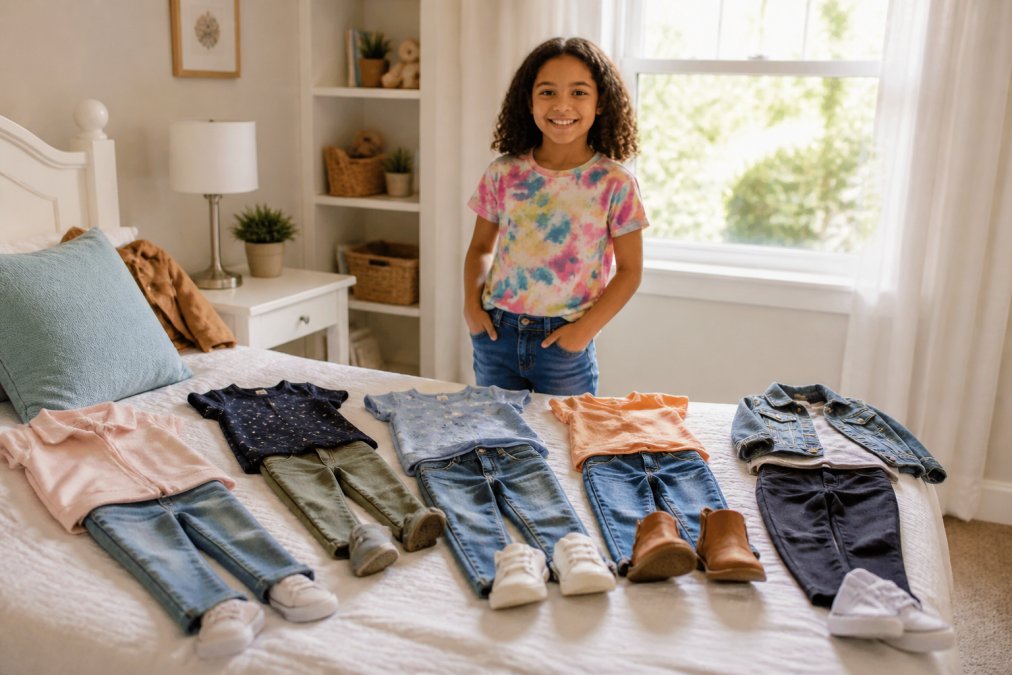
- Graphic tee plus joggers. The everyday default. A bright colorful character shirt with soft joggers handles school, errands, and backyard play without a single complaint about the neckline.
- Long-sleeve tee plus jeans. For cooler mornings. A long sleeve layered under a tee gives warmth without bulk, and the layering piece can come off the moment the classroom heats up.
- Hoodie plus shorts. The seasonal transition outfit. A hooded sweatshirt over shorts works from early fall through late spring, and the kangaroo pocket is a genuine selling point for kids who like having somewhere to put their hands.
- Athletic tee plus cap. The sporty option. A moisture-wicking youth tee with a baseball cap reads as team-ready, which matters to eight-year-olds who care about looking the part.
- Smart-casual upgrade. Swap the joggers for clean jeans, add the hoodie as a layer, and the same pieces read as put-together for a birthday party or family event. No separate wardrobe required.
Budget-Friendly Shopping Strategies That Still Feel Stylish
Spending less on kids' clothing is mostly a timing and structure problem, not a coupon problem. Eight-year-olds grow fast, and anything bought for a single season is a poor investment. For a picky dresser there is a second layer: the budget strategy has to survive the child's veto. A cheap shirt that never gets worn is more expensive than a well-made one worn three times a week.


The Cost-Per-Wear Math That Actually Matters
Most parents default to the lowest sticker price, but the right metric for a picky eight-year-old is cost per wear. A $10 graphic tee refused after two wears costs $5 per wear; a $25 tee worn twice a week for a school year costs roughly $0.70 per wear. The expensive shirt is the cheaper shirt. This is not a justification for overspending, it is a reason to prioritize construction and comfort.
Strategies That Work With a Picky Dresser
- Buy versatile basics in multiples. If a child loves one tee, buy two. The favorite garment gets worn constantly, and having a backup prevents laundry-day meltdowns. This is the single highest-ROI move for picky dressers.
- Shop end-of-season for next year. Sizes are predictable enough at this age to buy one size up in basics. A hoodie bought in March costs a fraction of the same hoodie in October.
- Prioritize mix-and-match pieces over statement items. A statement piece gets worn twice; a versatile basic gets worn twice a week.
- Check construction, not just price. Reinforced seams, twill necktape, and ribbed collars are the difference between a garment that lasts a season and one that lasts a year. These details also tend to correlate with comfort, which matters for sensory-sensitive kids.
- Let the child pick one piece per shopping trip. A child who chose the hoodie is far more likely to wear it.
The Circular Fashion Angle Most Guides Miss
Children's clothing is one of the easier categories to shop sustainably, because garments are outgrown before they are worn out, making resale, hand-me-downs, and donation genuinely effective. For a picky dresser, secondhand shopping lets you test a style or fabric at a fraction of retail before committing to a full-price purchase.
- Buy one pre-loved version of a style your child is curious about. A thrifted or resale version is a low-risk test of a new silhouette or fabric.
- Pass along what does not work. A rejected garment may be perfect for another family, keeping usable clothing in circulation.
- Look for durable construction in secondhand pieces. A hoodie with twill necktape and a shape-holding blend can survive two or three children; a fast-fashion equivalent often cannot survive one.
- Teach the hand-me-down conversation. An eight-year-old who understands clothes get passed on is more willing to try a pre-loved piece, especially framed as a smart choice rather than a compromise.
Sustainable and Circular Fashion for Kids
The sustainable move at this age is to buy fewer, better-made pieces and pass them along when they no longer fit. Durable construction supports that cycle: a hoodie with twill necktape and a shape-holding blend can survive two or three children, while a fast-fashion equivalent often cannot survive one.
Frequently Asked Questions
What are the best fabrics for sensory-sensitive children?
Breathable cotton, Airlume combed cotton, and moisture-wicking polyester work well for kids with texture sensitivity. Look for tagless labels, flat seams, and soft fabrics that won't scratch. Avoid rough wool or stiff denim. A lightweight cotton tee like the Walabookies graphic tee ($18.82) uses tear-away labeling to prevent irritation, making it a solid choice for sensory friendly clothes for kids.
How do I build a capsule wardrobe for an 8-year-old?
Start with 8-10 versatile basics: 3-4 tees, 2 pairs of jeans or joggers, 1 hoodie, and 1-2 layering pieces. Choose mix-and-match colors so every top works with every bottom. For picky 8 year olds, let them pick the graphics or colors within your approved options. A capsule wardrobe for 8 year olds cuts morning decisions and keeps outfit coordination simple.
How do you handle a child who is picky about their clothes?
Give limited choices rather than open-ended ones. Offer two pre-approved outfits and let them pick. Involve them in shopping so they feel clothing autonomy. Focus on tactile comfort first, then style. If texture sensitivity is the issue, try sensory friendly clothes for kids with tagless labels and soft fabrics before assuming it's just stubbornness.
What should I look for in school-appropriate outfits for picky 8 year olds?
Prioritize durable materials, stretch waistbands, and breathable cotton that survive recess and wash cycles. Smart-casual pieces like a graphic tee under a hoodie work for both classroom and weekend outfits. Check that everything is machine washable and holds shape. The Walabookies hoodie ($39.99) uses 50/50 cotton-poly fleece that keeps its shape and holds prints well.