
Table of Contents
- Start by Purging and Decluttering
- How to Organize Kids Clothes by Size
- Categorize Clothing by Type and Season
- How to Organize a Small Kids Closet with Vertical Space
- Kids Closet Organization Bins and Storage Solutions
- Create Zones for Daily Outfits and Easy Access
- How to Store Outgrown Kids Clothes and Hand-Me-Downs
- Label and Maintain Your Organized Closet
- Frequently Asked Questions
Last Updated: October 8, 2026
Start by Purging and Decluttering
The first step to how to organize a kids clothing closet is to remove what doesn't work anymore. Kids grow fast. Clothes shrink, wear out, or just don't fit their style anymore.
Pull everything out of the closet. Yes, everything. Lay it on the bed or the floor so you can see what you're working with.
Be honest about what stays. If something hasn't been worn in six months, it's taking up space. Create three piles: keep, donate, and hand-me-downs (we'll cover that later).
This process usually takes an afternoon, but it makes the rest of organizing so much easier. You're not trying to fit 200 items into a small space.
How to Organize Kids Clothes by Size
Once you've purged, sort by size. This is especially helpful if you have multiple children or plan to keep hand-me-downs.
Create sections for each size: 2T, 3T, 4T, 5-6, 7-8, and so on. If your child is between sizes right now, keep current-size clothes in the main closet and store the next size up in a bin or separate area.
This approach saves time when you're getting dressed in the morning. You're not digging through 4T shirts when your kid wears 5-6. Everything fits, everything works.
Label each section clearly so anyone in your household knows where to find clothes. Use a permanent marker on bins or a label maker for a neater look.
| Size Range | Storage Location | Rotation Schedule |
|---|---|---|
| Current size | Main closet | Daily access |
| Next size up | Upper shelf or bin | Check every 3 months |
| Outgrown clothes | Storage area | Move to hand-me-downs |
| Seasonal items | Under bed or closet shelf | Rotate twice yearly |
Categorize Clothing by Type and Season
Organizing by type makes getting dressed faster and easier. Group similar items together: shirts with shirts, pants with pants, dresses with dresses.
Within each category, you can organize further by color, pattern, or season. Many parents find it helpful to separate warm-weather clothes from cold-weather clothes, especially if space is tight.
Keep everyday basics front and center. Save special occasion clothes for a separate shelf or bin. Your child should be able to reach daily clothes without your help.
If you have limited closet space, rotate seasonal clothing. Store winter coats and sweaters in a bin during summer. Bring them back when the temperature drops. This frees up hanging space for what your child actually needs right now.
How to Organize a Small Kids Closet with Vertical Space
Most guides assume a standard closet. The harder reality is a shared closet between siblings or a bedroom with no closet at all. Here is how to solve both without remodeling.
Shared closet between two kids
Divide the closet vertically, not horizontally. Each child gets a full-height column. Install a second rod on one side only, so one child has double-hang space and the other has a single rod plus shelves above.
Use color-coded bins or washi tape on the rod ends to mark whose side is whose. A common pattern is to give the older child the higher rod and the younger child the lower rod, then swap as they grow.
If the closet has a single door, add a tension rod across the middle at kid height. Hang a lightweight fabric organizer with clear pockets for each child's socks, underwear, and hair accessories. This keeps small items separated without taking shelf space.
No closet at all
Turn a wall into a closet using a freestanding garment rack with a bottom shelf. Look for one with adjustable height so the rod can be lowered as your child grows. Place it in a corner or behind the door.
Add stackable open cubes beside the rack. Use the top cube for folded shirts, the middle for pants, and the bottom for shoes or a laundry basket. Label each cube with a simple icon or word.
For under-bed storage, use shallow rolling bins that fit between the bed frame and floor. These work well for off-season clothes or hand-me-downs. Measure the gap first; most beds have 6 to 9 inches of clearance.
Vertical tricks that actually save space
- Double-hang rods: Install a second rod 32 to 40 inches below the first. This works for shirts, skirts, and folded-over pants. Keep dresses and long coats on the original rod.
- Over-the-door shoe organizer: Use it for rolled socks, underwear, hats, and gloves. Cut the bottom row off if it hits the floor.
- Wall-mounted hooks: Place a row of hooks at your child's shoulder height for backpacks, jackets, and tomorrow's outfit. This keeps daily items off the floor.
- Shelf risers: Use small wire risers inside a shelf to create two levels for folded clothes. This doubles shelf capacity without installing new shelves.
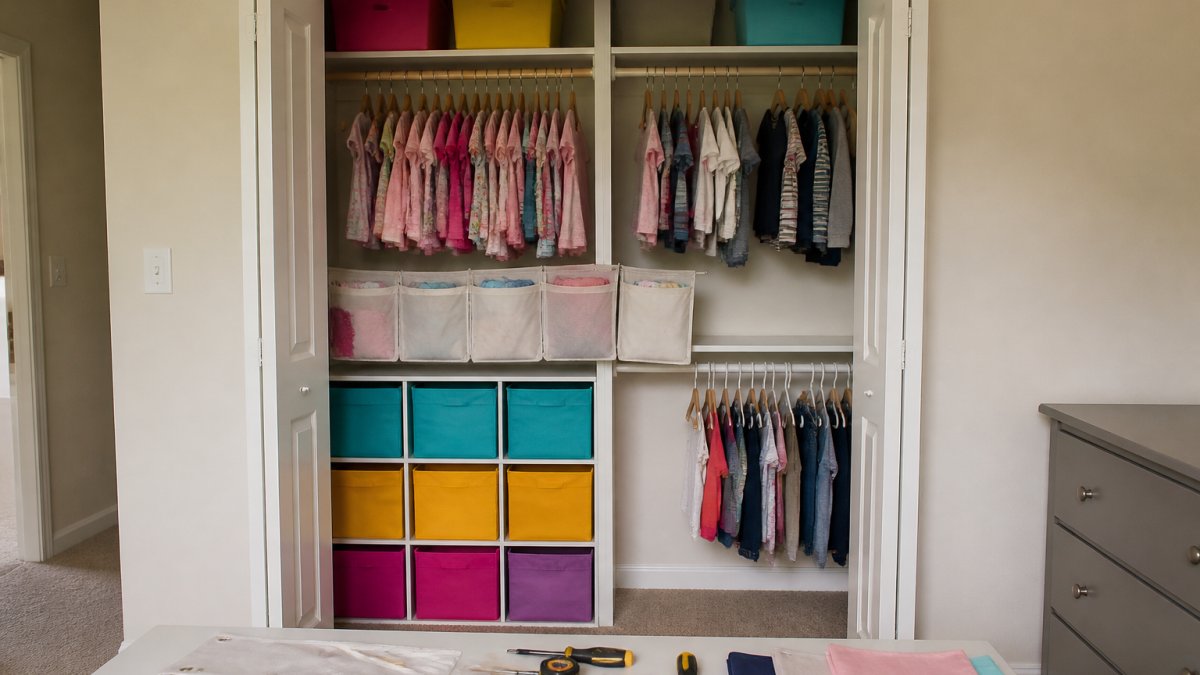
Kids Closet Organization Bins and Storage Solutions
Clear plastic bins are your best friend. You can see what's inside without opening them. Label each bin so you know what's stored where.
Use smaller bins for accessories: socks, belts, hair clips, mittens. Use larger bins for off-season clothes or hand-me-downs. Stackable bins save space and keep things organized.
Drawer dividers work well for folded clothes. They keep t-shirts, socks, and underwear from getting jumbled. Your child can find what they need without creating chaos.
Hanging organizers (the kind with clear pockets) work great for smaller items. Hang one on the back of the closet door or on the rod itself.
At Walabookies, we know that stylish storage makes organizing fun.
Create Zones for Daily Outfits and Easy Access
Divide your closet into zones based on how often items are worn. The "daily wear" zone should be at eye level and easy to reach.
Create an "special occasion" zone for dressier clothes. Keep these on a higher shelf or in a separate bin.
Set up a "getting dressed" zone where your child can put together outfits. Some parents lay out tomorrow's clothes the night before. Others let their child pick outfits in the morning.
Use shelf dividers or small bins to mark zone boundaries. This prevents clothes from sliding around and keeps zones separate.
If your child is old enough, let them help create the zones. Kids are more likely to maintain a system they helped design.
How to Store Outgrown Kids Clothes and Hand-Me-Downs
Outgrown clothes don't need to take up prime closet real estate. Store them elsewhere.
Use clear plastic bins and label them by size and season.
Include a list on the outside of each bin showing what's inside. This saves time when you're looking for a specific item later.
If you're saving clothes for a younger sibling, organize the same way. Keep current-size clothes accessible and next-size-up clothes in labeled bins.
Donate clothes you're not keeping. Don't let "maybes" clog your system. If you're not confident you'll use them, let them go.
For hand-me-downs coming in from relatives, treat them the same way. Sort by size, label clearly, and store in bins until they're needed.
Label and Maintain Your Organized Closet
Labels and maintenance are what keep the closet from sliding back into chaos. But most systems fail because they assume a neurotypical child who reads text labels and remembers routines. Here is a maintenance plan that works for all kids, including those with ADHD or autism.
Labeling that works for every brain
Text labels are fine for strong readers. For pre-readers or kids who process visuals better, use a photo or icon label instead. Take a picture of the folded shirts, print it, and tape it to the bin.
Color-code by category, not by child. For example, all socks go in a blue bin, all pants in a green bin. This removes the need to read anything. A common pattern is to use the same color for the same category across both kids' zones.
For kids with ADHD or autism, reduce the number of labels. Too many choices cause decision fatigue. Start with three bins: tops, bottoms, socks-and-underwear. Add more only when the child can maintain those three.
A maintenance schedule that sticks
Daily (2 minutes): Before bed, have your child put tomorrow's clothes on a hook or in a designated bin. This removes morning friction.
Weekly (10 minutes): Pick a consistent day, like Sunday evening. Do a quick reset: return stray items to their bins, refold anything that has unfolded, and empty the laundry basket.
Monthly (20 minutes): Check for outgrown items. Try on one or two pieces from each category. If they are too small, move them to the hand-me-down bin immediately. Do not wait for a seasonal change.
Quarterly (30 minutes): Do a full size check. Measure your child's height and compare to the size chart. Rotate seasonal clothes. Wipe down shelves and bins.
Teaching independence without overwhelm
For neurodivergent kids, the closet itself can be overstimulating. Reduce visual noise by using solid-colored bins instead of clear ones. Clear bins show everything at once, which can be overwhelming.
Limit the daily wardrobe to five outfits. Hang them together on a low rod. This removes the "what do I wear" decision and makes dressing a simple sequence.
Use a visual checklist on the inside of the closet door: 1) pick top, 2) pick bottom, 3) pick socks, 4) get dressed.
If your child struggles with textures, keep a small "comfortable clothes" bin at eye level. These are the items they will actually wear.
At Walabookies, we know that playful, silly designs can make getting dressed feel less like a chore. The Walabookies merchandise is inspired by the fun, funny, and silly Walabookies kids book on Amazon.

Frequently Asked Questions
How often should you declutter a child's closet?
Most families benefit from decluttering every 3-4 months, especially with growing children. A quick seasonal purge catches outgrown items before they take up valuable space. For fast-growing toddlers, consider sorting every 6-8 weeks. This keeps your closet functional and makes room for new pieces that actually fit and get worn.
What's the best way to organize kids clothes by size when they grow so quickly?
Sort by size first, then by type within each size category. Use clear storage bins or labeled drawer dividers to separate 12-18 months, 2T-3T, and so on. Keep the current size at eye level for easy access, and store the next size up on a higher shelf. This system makes it simple to rotate clothes as your child grows and helps you avoid buying duplicates.
How do I teach my child to keep their closet organized?
Start by making it accessible: place frequently worn items at their eye level, use lower hanging rails for their reach, and keep a simple color-coded or picture-labeled system they can understand. Let them help sort and choose outfits from a small selection. Children are more likely to maintain organization when they've had a hand in creating it and can easily see and grab what they need.
Where should I store outgrown kids clothes I want to keep?
Store outgrown items in clear, labeled bins in a cool, dry place like a closet shelf, under-bed storage, or a spare room. Label each bin by size and season so you can quickly find pieces for younger siblings or future children. Keep the bins off the floor to protect from moisture and pests. Rotate seasonal storage bins annually to make space in your main closet for current sizes.