
Table of Contents
- What GOTS Certification Means for Kids Clothing
-
How to Verify GOTS Certification on a Garment
- Step 1: Look for the GOTS Logo and License Number
- Step 2: Check the Product Label for Certification Details
- Step 3: Search the Official GOTS Database, and Read the Result Correctly
- Step 4: Request the Transaction Certificate (TC) for High-Value or Bulk Purchases
- Step 5: Cross-Check the Certification Body
- Understanding GOTS Label Requirements
- GOTS Organic vs Made with Organic Materials
- GOTS vs OEKO-TEX: What's the Difference
- Common Misleading Claims and What to Avoid
- Why GOTS Certification Matters for Your Child
- Frequently Asked Questions
Last Updated: October 17, 2026
What GOTS Certification Means for Kids Clothing
GOTS certified kids clothes are made from organic fibers and produced under strict environmental and social standards. The Global Organic Textile Standard, or GOTS, is the world's leading certification for organic textiles.
What makes GOTS different from other certifications is its scope. It doesn't just check the fiber, it tracks the entire supply chain. From the farm where cotton grows, through processing, dyeing, and manufacturing, every step must meet GOTS requirements.
At Walabookies, we focus on quality pieces that parents can trust. When you see GOTS certification on kids' clothing, you know the garment was made with care.
This matters because kids have sensitive skin. They wear their clothes every day. Parents want to know what touches their child's body is truly clean and safe.
How to Verify GOTS Certification on a Garment
Finding authentic GOTS certified clothing requires checking multiple sources. Don't rely on marketing claims alone. Follow these steps to confirm a garment is genuinely certified, and to understand what each check actually proves.
Step 1: Look for the GOTS Logo and License Number
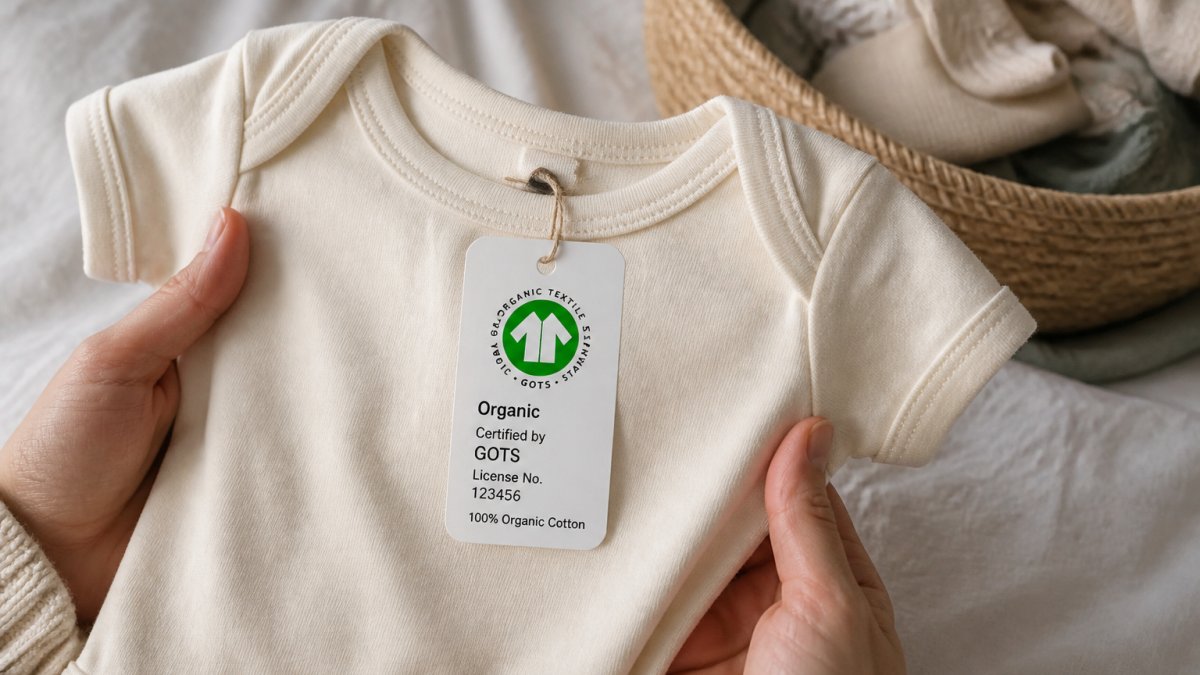
The GOTS logo appears on product labels, hang tags, or packaging. It's a green circle with white text. The logo alone isn't enough proof.
Below or near the logo, you'll find a license number. This is a unique code assigned to the certified entity, usually the manufacturer or brand, not the farm. The license number is your key to verification.
Write down this number exactly as printed. You'll use it in the next step to search the official database.
Step 2: Check the Product Label for Certification Details
Read the entire label carefully. GOTS certified products display specific information:
- The GOTS logo (green circle)
- The license number (usually starts with a country code)
- The certification claim (e.g., "GOTS certified" or "Made with organic fibers")
- The percentage of organic fiber content
The label should state whether the garment is "GOTS certified" or "Made with Organic" (a lower tier). These are different categories.
Look at the care instructions too. GOTS garments often have specific washing guidance because the dyes and finishes are gentler.
Step 3: Search the Official GOTS Database, and Read the Result Correctly
Visit the official GOTS website and use their certified supplier search tool. Enter the license number you found on the label.
The database will show:
- The company name and location
- The certification status
- What products they're certified to make
- The certification scope (which stages of production are covered)
What the database result does prove: that the company holds a valid GOTS certification for the scope listed. It confirms the license number is real and the certification body has audited that entity.
What the database result does NOT prove: that the specific garment you're holding was made under that certification. A company can be certified for, say, fabric processing but not for finished garment manufacturing. Or it may be certified for a product category that doesn't include the item in your hand.
If the license number doesn't appear in the database, the garment is not genuinely GOTS certified. This is a red flag.
Take a screenshot of the database result. Keep it for your records.
Step 4: Request the Transaction Certificate (TC) for High-Value or Bulk Purchases
For a single garment, the label and database check are usually enough. But if you're buying in bulk, reselling, or want the strongest possible proof, ask the brand for the transaction certificate (TC) that covers the specific batch.
A TC is issued by the certification body for each shipment or sale of certified goods. It links the certified entity to the specific product and quantity. The TC will show:
- The seller and buyer
- The product description and quantity
- The certification reference
A legitimate brand should be able to provide a TC or point you to the certification body that issued it. If they can't or won't, treat the claim with caution.
Step 5: Cross-Check the Certification Body
GOTS certifications are issued by independent certification bodies (such as Control Union, Ecocert, or Soil Association Certification). The database result or the label often names the certifier. You can cross-check with that body's own database if you want a second source.
This step is optional for most shoppers, but it's useful if the GOTS database result is ambiguous or if you're verifying a supplier for a business.
Understanding GOTS Label Requirements
GOTS labels must follow specific rules. The certification body requires clear, honest labeling so shoppers know what they're buying. But the label grades are often misreported, here's what the standard actually says.
GOTS defines two main label grades for finished products, based on the percentage of certified organic fiber in the garment:
"GOTS certified" (or "organic"), the finished garment contains at least 95% certified organic fiber. The remaining up to 5% can be conventional materials like elastane or nylon for stretch. This is the higher grade.
"Made with organic", the garment contains at least 70% certified organic fiber. The rest is conventional material. This is a valid GOTS label grade but a lower threshold.
A common mistake is to assume that "100% organic cotton" automatically means "GOTS certified." That's not quite right.
The label must state the fiber percentage and the applicable grade. If it says "100% organic cotton" without a GOTS logo or license number, it's an organic-content claim, not a GOTS certification.
Labels also show the certification scope. Some manufacturers are certified for fiber production only. Others are certified through dyeing and finishing.
GOTS Organic vs Made with Organic Materials
The difference between these two categories matters.
GOTS certified garments contain 95% or more organic fiber. They meet the highest standard. Every stage of production, from growing the cotton to dyeing and finishing, follows GOTS rules.
Cute Yellow Robot Baby Bodysuit — Organic Short Sleeve Onesie →
Made with Organic garments contain 70-94% organic fiber. They still meet GOTS standards, but the threshold is lower. This category allows more conventional materials mixed in.
Why would a brand choose "Made with Organic"? Elastane and nylon add stretch and durability.
For kids' clothes, the difference is practical. A GOTS certified onesie might be pure organic cotton.
Both are legitimate GOTS products. The label tells you which one you're buying.
Check what matters most to your family. If you want pure organic fiber, look for the 95%+ garments. If durability and stretch matter more, "Made with Organic" is still a safe choice.
GOTS vs OEKO-TEX: What's the Difference
These are two different certification systems. They measure different things.
GOTS focuses on the fiber being organic and the entire supply chain following environmental and social rules.
OEKO-TEX certifies that a finished textile is free from harmful chemicals. It tests the final product for toxins like heavy metals, azo dyes, and formaldehyde.
A garment can be OEKO-TEX certified but made from conventional cotton grown with pesticides.
For kids' clothing, many parents want both. GOTS ensures the fiber is clean and the production was ethical. OEKO-TEX ensures the finished garment has no toxic residues.
Look at the Cute Yellow Robot Baby Bodysuit from Walabookies. It carries both OEKO-TEX and GOTS certifications.

If a label shows only one certification, ask yourself what matters most. Pure organic fiber? Choose GOTS. Chemical-free finished product? Choose OEKO-TEX. Both?
Common Misleading Claims and What to Avoid
Many brands use language that sounds like certification but isn't.
"Made with organic materials" without a logo or license number is a marketing claim, not a certification. There's no third-party verification.
"Eco-friendly" or "sustainable" are vague words. They don't mean the garment is certified or tested by anyone. Any brand can use these words.
"Natural fibers" doesn't mean organic. Cotton is natural, but conventional cotton is sprayed with pesticides. Natural ≠ organic.
"Non-toxic" is a common claim but it's not verified. Only OEKO-TEX and similar certifications actually test for toxins.
"Ethically made" sounds good but without a certification number, there's no proof. A brand can claim this without auditing their factories.
Real certifications have logos, license numbers, and searchable databases.
Be skeptical of brands that use certification language but don't show the official logo. Ask for the license number.
Why GOTS Certification Matters for Your Child
Kids' skin is more sensitive than adult skin (Change in skin properties over the first 10 years of life: a cross-sectional study).
GOTS certification removes several risks:
- No synthetic pesticides on the fiber. Conventional cotton is sprayed heavily. Organic cotton is grown without these chemicals.
- No harsh dyes. GOTS restricts azo dyes, heavy metals, and other toxic finishing chemicals.
- No formaldehyde. Many conventional garments are treated with formaldehyde to prevent wrinkles and mildew (Early-Life Exposure to Formaldehyde through Clothing).
- Fair labor practices. GOTS requires safe working conditions and fair wages. Your money supports ethical production.
When your child wears GOTS certified clothing, you reduce exposure to toxins. The fabric is processed gently.
This is why parents choose certified organic for babies and young children. Their immune systems are still developing. Their skin is still learning to protect itself.
Walabookies offers GOTS and OEKO-TEX certified pieces like the Cute Yellow Robot Baby Bodysuit. These garments are designed for delicate skin. The organic cotton is breathable and gentle.
Finding GOTS certified kids clothes means checking three things: the official logo, the license number, and the database verification. Don't rely on marketing claims alone.
When you choose certified garments, you're investing in your child's health and supporting ethical production.
Frequently Asked Questions
How can I tell if kids' clothes are GOTS certified?
Check the product label for the GOTS logo and a license number. Search that license number in the official GOTS certified supplier database to verify the brand and product scope. Look for hang tags or product descriptions that mention GOTS certification. Authentic GOTS certified kids clothes will display the certification clearly, and the brand should provide details about fiber content and processing standards.
What is the difference between GOTS organic and made with organic materials?
GOTS certified organic means at least 95% of the fiber content is certified organic. Made with Organic indicates 70-94% certified organic fiber content. Both require compliance with environmental and social standards, but GOTS organic represents a higher threshold of organic material. Always check the percentage on the label to understand exactly what you're purchasing for your child.
Are GOTS and OEKO-TEX the same certification?
No, they serve different purposes. GOTS focuses on organic fiber content, environmental criteria, and social standards throughout the supply chain. OEKO-TEX certifies that finished textiles are free from harmful substances and meet safety requirements for children's clothing. Many quality kids' garments carry both certifications, like the Cute Yellow Robot Baby Bodysuit from Walabookies, which offers dual OEKO-TEX and GOTS certification for maximum assurance.
What should I check if a product listing says it is GOTS certified?
Verify the GOTS license number on the label, check the organic fiber percentage, and confirm the brand appears in the official GOTS certified supplier database. Look for details about which garment parts are certified (some items may have only certified fabric but non-certified trims). Read care instructions to ensure the garment will hold up through washing. Check product reviews to see how the item performs over time with your child.