
Table of Contents
- Why Kids Clothes Sizing Matters
- How to Measure Your Child for Clothes at Home
- Kids Clothing Size Chart by Age and Height
- Understanding Age-Based vs. Height-to-Weight Sizing
- Buying Premium Organic Cotton Kids Apparel
- Accounting for Growth Spurts and Seasonal Changes
- Common Sizing Mistakes to Avoid
- Frequently Asked Questions
Last Updated: September 30, 2026
Why Kids Clothes Sizing Matters
Getting the right fit for your child's clothes sounds simple. It's not. A shirt that's too tight restricts movement. One that's too loose gets caught on things. Pants that don't fit the inseam properly drag or expose ankles. When sizing is off, kids feel uncomfortable, and uncomfortable kids won't wear what you buy.
The good news: finding the right kids clothes sizing is straightforward once you know what to measure and how to read size charts. This guide walks you through the exact process, from taking measurements at home to understanding how different brands approach sizing.
How to Measure Your Child for Clothes at Home
Taking accurate measurements is the foundation of getting the right fit. You need just three things: a soft measuring tape (fabric, not metal), a notebook, and about five minutes. Precision matters, even a half-inch difference changes how clothes fit.
Start with your child standing relaxed in light clothing or undergarments. Tight clothes distort measurements. Avoid measuring over heavy sweaters or bulky layers. Have your child stand with arms relaxed at their sides and feet about hip-width apart. If your child is very young or wiggly, take measurements twice and average them to reduce error.
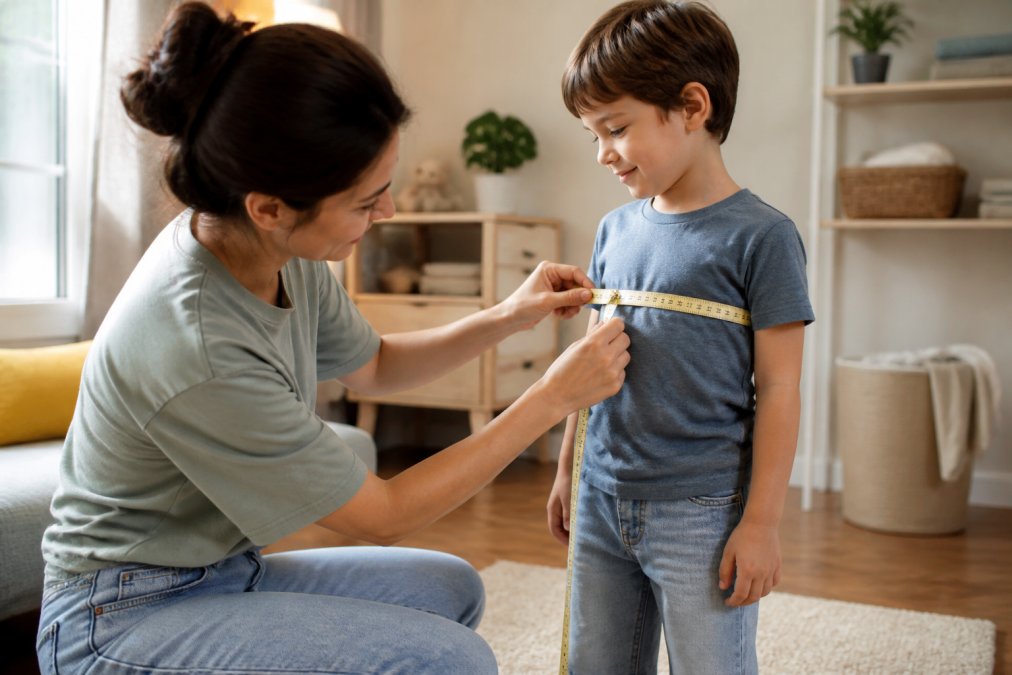
Measuring chest circumference and waist
Chest circumference is the fullest part of the chest, usually just below the armpits. Wrap the tape around the widest point horizontally, keeping it snug but not tight. You should be able to slip one finger under the tape without resistance. The tape should sit parallel to the ground, not angled up or down. Write this number down to the nearest quarter-inch.
Waist measurement comes next. Find the natural waist, usually where your child's belly button sits or where they naturally bend when they lean to the side. Wrap the tape around this area horizontally, again keeping it snug without squeezing. This measurement helps with pants and shorts fit. For children with undefined waists, measure at the narrowest point between the ribs and hips.
Both measurements should be taken to the nearest quarter-inch. Rounding up or down by a full inch changes how clothes fit significantly.
Finding inseam and sleeve length
Inseam determines pants length and is one of the most commonly overlooked measurements. Have your child stand barefoot with feet slightly apart (about hip-width). Measure from the inside of the thigh, starting at the crotch seam area, straight down to the ankle bone (the bony bump on the inside of the ankle). Keep the tape vertical and taut but not pulled tight. This measurement should be taken to the nearest quarter-inch. Inseam is critical: a child with a 24-inch inseam needs 24-inch pants regardless of their age or weight.
For sleeve length, measure from the center back of the neck, across the shoulder, and down the arm to the wrist bone (the bony bump on the inside of the wrist). Keep the tape relaxed, it shouldn't pull tight around the arm or shoulder. Have your child keep their arm relaxed at their side during this measurement. Sleeve length is especially important for children with proportionally longer or shorter arms relative to their height.
Write all four measurements down: chest, waist, inseam, and sleeve length. These numbers are your reference for every brand you shop. Update them every 2-3 months during fast-growth periods (typically ages 2-5 and 10-13) to catch growth spurts before clothes become too small.
Kids Clothing Size Chart by Age and Height
Size charts vary by brand, but most follow age-based and height-to-weight ranges. Understanding both helps you make better choices.
Toddler sizing (0-3 years)
Toddler sizes typically run from newborn (0M) through size 3T. Toddler clothes are cut wider through the torso and shorter in the sleeves to match toddler proportions.
The Walabookies Kids Cartoon Crew Baby Bodysuit comes in sizes from 0M to 18M, with width ranging from 7.87 inches to 9.45 inches and length from 13.39 inches to 17.72 inches. This range covers most infants through early toddlers.
At this age, growth happens fast. Many parents buy one size up to extend the wearing window. However, clothes that are too large create safety risks, loose fabric can catch on objects or in doors.
Big kid sizing (4-12 years)
Big kid sizing typically starts at XS and goes through XL, though some brands use numbered sizes (6, 8, 10, 12, 14). This range covers ages 4 through early teens.
The Walabookies Kids Graphic Tee offers sizes XS through 4XL, with chest widths from 16.5 inches to 30 inches and lengths from 27 inches to 34 inches. This wide range lets you find exact fits across different body types.

Sleeve length becomes more important in this age group. Many kids have longer or shorter arms relative to their height. Using the sleeve measurement you took ensures shirts fit properly at the wrist.
Kids Graphic Tee "Walabookies" Colorful →
Understanding Age-Based vs. Height-to-Weight Sizing
Most kids clothes brands use age as a starting point, but age alone doesn't determine fit. Two 6-year-olds can have completely different chest circumferences and heights.
Age-based sizing works as a rough guide. A "6-year-old" size assumes average height and weight for that age. If your child is taller, heavier, or leaner than average, age sizing will be off.
Height-to-weight sizing is more precise. Brands that use this approach list ranges like "Height 42-48 inches, Weight 40-60 pounds." This accounts for individual variation better than age alone.
The best approach: measure your child, then check the brand's size chart using measurements rather than age. If a brand offers both age and measurement-based sizing, use the measurement chart.
Buying Premium Organic Cotton Kids Apparel
When shopping for kids clothes, material quality affects both comfort and durability. Organic cotton is breathable, soft, and holds up through repeated washing.
The Walabookies Toddler Long Sleeve Tee is made from 100% combed, ring-spun cotton with a lightweight 4.5 oz/yd² fabric. The ribbed collar and cuffs maintain shape after washes. Tear-away labels prevent irritation on sensitive skin.

Organic cotton costs more upfront, but it lasts longer and feels better against kids' skin.
Accounting for Growth Spurts and Seasonal Changes
Kids grow unpredictably, but growth isn't entirely random. Understanding growth patterns helps you buy clothes strategically and avoid waste.
Recognizing growth spurt patterns
Growth happens in phases. Infants and toddlers (ages 0-3) grow fastest, often gaining 4-6 inches per year. This slows to 2-3 inches per year from ages 4-8. Then growth accelerates again during the pre-teen and early teen years (ages 9-14), when children can grow 3-5 inches annually during peak growth periods.
Predicting growth to avoid waste
To estimate future growth, track your child's measurements every 2-3 months and plot them on a simple chart. Look for patterns: Is growth steady, or does it happen in bursts? Once you identify the pattern, you can predict roughly when the next size up will be needed.
Seasonal shopping strategy
Seasonal changes affect both what your child needs and how clothes fit. Summer clothes in lighter fabrics (3-4 oz/yd² cotton) feel better in heat. Winter layers in heavier weights (5+ oz/yd²) provide warmth and durability through repeated washing.
Common Sizing Mistakes to Avoid
Buying too large to "get more wear" out of clothes. Oversized clothes look sloppy and create safety risks. Your child will outgrow clothes by height and length, not by growing into them.
Frequently Asked Questions
What's the difference between toddler sizing and big kid sizing?
Toddler sizes (2T, 3T, 4T) are cut wider and shorter to fit a toddler's body proportions, they have more room through the belly and chest and shorter sleeves and inseams. Big kid sizes (XS, S, M, L) are narrower and longer, designed for children aged 4 and up with more defined waists and longer limbs. A child wearing 5T will need to move to XS when they're ready for the big kid cut, which usually happens around age 5 or 6, depending on their height and build.
How do I know if my child should size up or size down?
Check the garment's size chart against your child's actual measurements, chest circumference, waist, length, and inseam. If your measurements fall between two sizes, choose based on what matters most: if your child is between sizes for length, size up to avoid outgrowing it quickly; if the chest or waist is tight, size up for comfort. Always leave about one inch of room at the chest and waist so they can move and breathe. Most kids' clothing has some fabric stretch, which gives you a bit of flexibility.
Why do kids clothes sizing vary so much between brands?
Each brand sets its own fit standards. Some run large, others run small, and some use different body proportions than competitors. A size M from one brand might fit very differently from a size M at another retailer. This is why checking the specific size chart for each brand is crucial, don't assume your child's usual size will fit. Walabookies provides detailed garment measurements (chest width, length, sleeve length) so you can compare directly to what your child is wearing now.
How do I measure my child accurately with a measuring tape?
Use a soft fabric measuring tape, not a rigid ruler. For chest circumference, measure around the fullest part of the chest with the tape snug but not tight. For waist, measure at the narrowest point. For length, measure from the shoulder down to where you want the shirt to end. For inseam, have your child stand barefoot and measure from the inner thigh down to the ankle bone. Write down each measurement and compare them to the brand's size chart. Measure when your child is relaxed and wearing minimal clothing for accuracy.