
Table of Contents
- Start With a Kids Capsule Wardrobe Checklist
- How Many Clothes Does a Child Need?
- Pick a Color Palette That Mixes and Matches
- Kids Capsule Wardrobe Outfit Ideas for Every Day
- Build a Seasonal Capsule Wardrobe for Kids
- Fit, Growth Spurts, and Replacing Outgrown Items
- Frequently Asked Questions
Last Updated: October 9, 2026
Start With a Kids Capsule Wardrobe Checklist
A kids capsule wardrobe is a small, deliberately chosen set of clothing that mixes and matches into many outfits, so you buy fewer pieces and use every one. This guide from Walabookies walks through the checklist, the quantities, and the color rules that make a capsule actually work for a real child.
A capsule works because it removes decisions. Instead of a drawer stuffed with single-purpose items, your child gets a short list of pieces that all coordinate.
The Core Pieces Every Capsule Needs
Most capsules cover the same ground:
- 6 to 8 everyday tops
- 4 to 6 bottoms
- 2 to 3 layering pieces
- 1 to 2 outerwear items
- 1 to 2 sets for special occasions
Walabookies carries playful graphic tees, long-sleeve tees, hoodies, and baby bodysuits that slot into these categories, so you're not hunting across ten stores for basics that actually coordinate.

How to Use the Checklist Without Overbuying
Treat the checklist as a limit, not a shopping list. Count what your child already owns first, then fill only the gaps. A common mistake is buying a full capsule in one trip and ending up with four similar tops and no bottoms that work with them.
How Many Clothes Does a Child Need?
A workable number for most children is roughly 30 to 40 items in total, including tops, bottoms, layers, and outerwear. That range covers a full week of outfits with room for laundry timing.
The honest answer depends on how often you run the washing machine. Families who wash twice a week can sit at the low end. Families who wash once a week need closer to the high end, plus a couple of spares for spills.
Match Quantities to Your Laundry Routine
| Laundry Frequency | Tops | Bottoms | Layers | Notes |
|---|---|---|---|---|
| Twice weekly | 6 | 4 | 2 | Lean capsule, quick turnover |
| Once weekly | 8 | 5 | 3 | Add 1 spare top for spills |
| Every 10 days | 10 | 6 | 3 | Keep 2 extra bottoms on hand |
Count your own routine before you buy. Guessing here is what leads to a drawer full of clothes nobody wears.
Pick a Color Palette That Mixes and Matches
The fastest way to make a capsule work is to lock in two base colors and one or two accent colors, then buy almost everything inside that range. Base colors are the neutrals, things like navy, grey, white, and denim blue. Accent colors are the fun ones, and this is where kids get to choose.
Let your child pick the accent. If they love bright green, buy green in one or two pieces and keep the rest neutral. That way every top has something to match, and your child still feels like the wardrobe is theirs.
Pastel tones and earthy tones both work well as bases. The rule is consistency, not taste.
Kids Capsule Wardrobe Outfit Ideas for Every Day
A capsule earns its keep in the morning rush, when a child can grab any top and any bottom and the combination works. The math is simple: 8 tops × 5 bottoms = 40 potential outfits before you even add layers. That is why a capsule of 30-40 pieces can replace a drawer of 100 items that never quite match.
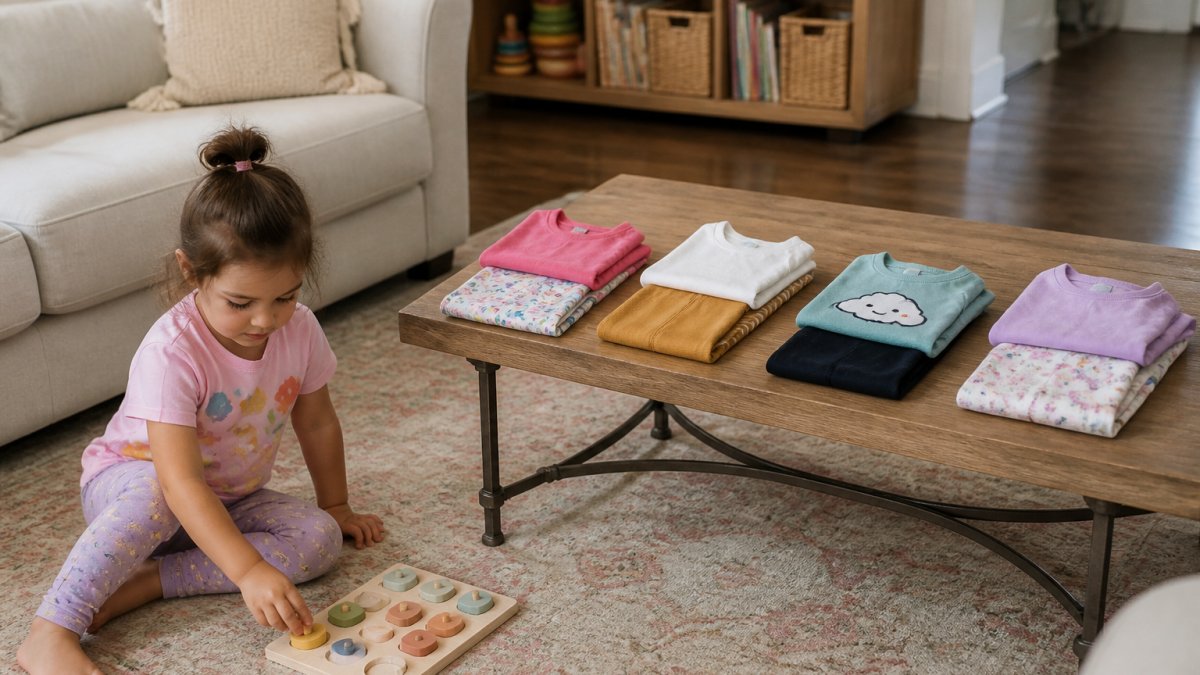
Here are five outfits that come straight out of the same short list, plus the age band each one suits best:
- Baby (0-18 months): Bodysuit, romper, and a light cardigan. Look for envelope necks and snap crotches for easy changes.
- Toddler (18 months-3 years): Graphic tee, leggings, and a zip hoodie. Elastic waists and pull-on styles let them dress themselves.
- Preschool (3-5 years): Long-sleeve tee, joggers, and sneakers. Add a vest for outdoor play without bulk.
- School-age (5-10 years): Tee, shorts or jeans, and a packable jacket. Check the school dress code for color and logo rules before you buy.
- Weekend/outdoor: Hoodie, jeans, and a beanie. Choose darker bottoms for mud and grass.
Notice that every outfit pulls from the same handful of pieces. That overlap is the point. To make it work in practice, store tops and bottoms in separate low drawers so a child can reach both without pulling everything out. A common pattern is to keep one "uniform" per day of the week: five school outfits, one outdoor outfit, one nice outfit. When laundry day comes, you refill the same seven slots instead of inventing new combinations.
If your child has sensory sensitivities, build outfits around the fabrics they already tolerate. Soft cotton tees and tagless labels reduce morning friction. For school uniforms, treat the uniform as its own capsule: buy the required pieces in the same base colors, then add two or three weekend pieces that match those colors so nothing is wasted.
Kids Graphic Tee "Walabookies" Colorful Character Shirt →
Build a Seasonal Capsule Wardrobe for Kids
A seasonal capsule swaps a few pieces rather than replacing everything. For warm weather, keep short-sleeve shirts, singlets, shorts, and dresses in rotation. For cold weather, bring in long-sleeve tops, warm layers, and outerwear. The trick is to keep the base colors identical across seasons. If summer is navy and white, winter should be navy and white too, so last season's bottoms still work with this season's tops.
Most guides stop there. The missing piece is climate. A capsule that works in San Diego will fail in Minneapolis, and a capsule that works in London will look different from one in Sydney. Use this method to adjust quantities to your actual weather:
| Climate type | Summer tops | Summer bottoms | Winter tops | Winter bottoms | Key layers |
|---|---|---|---|---|---|
| Hot/humid (e.g., Florida, Queensland) | 8 short-sleeve | 5 shorts | 4 long-sleeve | 3 pants | 1 light cardigan, 1 rain shell |
| Mild/coastal (e.g., UK, Pacific Northwest) | 6 short-sleeve | 4 shorts | 6 long-sleeve | 4 pants | 2 hoodies, 1 waterproof jacket |
| Cold/continental (e.g., Midwest, Ontario) | 4 short-sleeve | 3 shorts | 8 long-sleeve | 5 pants | 2 fleece layers, 1 insulated coat, 1 snow suit |
| Variable/four-season (e.g., Denver, Melbourne) | 6 short-sleeve | 4 shorts | 6 long-sleeve | 4 pants | 3 layers including 1 packable puffer |
Count your own climate before you buy. A family in a hot climate may only need two long-sleeve tops for the whole year, while a family in a cold climate may need eight. The goal is not a fixed number; it is enough pieces to cover the longest stretch between laundry days for your specific weather.

Layering Pieces for Changing Weather
Layering pieces do the heavy lifting in a kids capsule wardrobe, because they let one outfit handle a cold morning and a warm afternoon. A hoodie, a light cardigan, and a zip-up jacket cover most of the year in most climates. In colder regions, add a fleece mid-layer and an insulated outer layer. In wet regions, a waterproof shell matters more than a heavy coat.
Buy layers one size up. Kids wear them over other clothes, and a layer that fits snugly over a tee is useless in January. Look for layers with full-length zippers or large buttons so children can manage them independently.
A seasonal capsule also helps you budget. Instead of buying a whole new wardrobe twice a year, you replace only the pieces that no longer fit or have worn out. That keeps spending predictable and reduces the pile of clothes that never get worn.
Fit, Growth Spurts, and Replacing Outgrown Items
Children outgrow clothes on their own schedule, and a capsule has to survive that. Check fit every few months at the shoulders and waist, which are the first places a garment stops working.
Replace one item at a time as it fails, not the whole capsule at once. When a top gets too short, buy one replacement in the same base color so it still matches everything else.
A capsule also cuts waste. Fewer, better pieces get worn more often, which means less money spent on clothes that sit in a drawer.
Frequently Asked Questions
What is the 5-4-3-2-1 capsule wardrobe method for kids?
The 5-4-3-2-1 method is a simple ratio for building a capsule: five everyday tops, four bottoms, three layering pieces, two pairs of shoes, and one special outfit. It works well for kids because it keeps the total number of items small enough to mix and match easily. Adjust the numbers up for school-age children who need more wash cycles, or down for babies who grow out of sizes quickly.
How many clothes does a child need in a capsule wardrobe?
A practical starting point is 8 to 10 tops, 5 to 7 bottoms, 2 to 3 layering pieces, and 1 to 2 pairs of shoes. If you do laundry once a week, aim toward the higher end. If you wash every few days, you can stay closer to the lower end. The goal is enough outfits for a full week without a closet stuffed with pieces your child never wears.
How do you choose clothes that mix and match for kids?
Stick to two or three base colors like navy, grey, or white, then add one or two accent colors your child actually likes. Every top should work with at least three bottoms. Graphic tees, solid leggings, and a hoodie in coordinating colors give you dozens of combinations without buying more. Let your child pick the accent color so they feel ownership over the wardrobe.
How often should you update a child's capsule wardrobe?
Review the capsule at each season change and after any noticeable growth spurt. Most children need a full refresh every 6 to 12 months, though toddlers may outgrow sizes faster. Check fit at the shoulders and waist first, since those are the areas that stop working earliest. Replace only what no longer fits or has worn out, and keep the color palette consistent so new pieces still match.
What should a kids' back-to-school capsule wardrobe include?
A back-to-school capsule needs durable everyday tops, easy-wash bottoms, one warm layer like a hoodie, and closed-toe shoes. Check your school's dress code before buying, since some require collared shirts or forbid certain graphics. Add a lightweight long-sleeve tee for transitional fall weather. Keep the palette tight so your child can dress themselves without mismatched outfits.
How do you build a capsule wardrobe for a toddler?
Toddler capsules should prioritize comfort and easy changes. Choose soft cotton bodysuits, leggings with elastic waists, and long-sleeve tees that layer under overalls. Skip anything with fiddly fasteners. Aim for 10 to 12 tops and 6 to 8 bottoms because toddlers go through multiple outfits a day. Machine-washable fabrics matter more than style at this age.
Building a capsule takes an afternoon of counting and one honest look at your laundry routine. Walabookies makes the fun part easy, with colorful graphic tees, cozy hoodies, and soft organic bodysuits that mix into the neutral bases you already own. Start with our kids' collection, pick a couple of accent pieces your child will actually reach for, and build the rest of the capsule around them. Continue shopping and see how few pieces it really takes.